
22/02/2026 0 Comments
A Pilgrimage to Canterbury for the beginning of Lent 2026
A Pilgrimage to Canterbury for the beginning of Lent 2026
# News
A Pilgrimage to Canterbury for the beginning of Lent 2026
A Pilgrimage to Canterbury for the beginning of Lent 2026
It was at school, doing my O levels in the late ‘70s, that I first came across the Canterbury Tales. I studied the Prologue and the wonderful Nun's Priest's tale of Chanticleer, a vain and silly cockerel, his sensible wife Pertelote and a sly fox. It was a great introduction to the poetry of Geoffrey Chaucer, and to the activity of making a pilgrimage.
Some years ago, as a young family, we walked the Saint James’ Camino from Northern Portugal to Santiago de Compostela in Spanish Galicia. Pilgrimage is a bug. Once you've got it in your system, it's always there. I have long been thinking about making the pilgrimage from London to Canterbury; this year I had promised myself (and the Archdeacon) to make a retreat; why not spend my retreat walking prayerfully in the footsteps of so many making pilgrimage to the shrine of St Thomas Becket?
Becket is an interesting person. He was appointed Chancellor (effectively First Minister) and then Archbishop by Henry II who wanted a friend and counselor who would see things his way and take the king's part. Appointing Thomas was already an abuse of power. But once Thomas was ordained and in post the story shifted in ways the king never expected. Thomas spoke for the rights of the Church, not the wishes of the king and they were often at loggerheads until Henry, in frustration, said the fateful words ‘Will no one rid me of this meddlesome priest?’ Four loyal knights of King Henry heard this outburst and set off to Canterbury bent on murder. More abuse of power and influence in public life. A pilgrimage for peace and against abuse of power seemed a good use of my pre-Lent retreat, given the news from both sides of the Atlantic in early 2026.
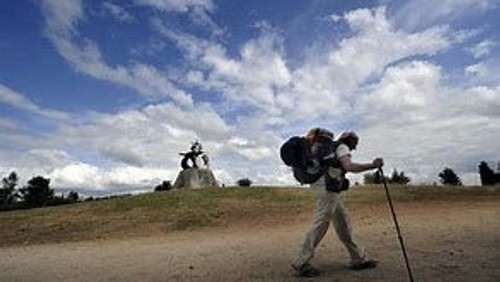
So on Monday 16 February I set off from home, through Greenwich, up onto Blackheath and then up to the top of Shooter's Hill. I expected this to be a hard slog, but was buoyed up by people who stopped me to talk, and wished me a good pilgrimage (I wore my pilgrim's shell throughout the walk, so there wasn't any doubt what I was doing). From Shooter's Hill I walked to the Thames at Erith where in the 1930s my grandfather (also Thomas) began his ministry as a curate. I know Erith Reach from the deck of my boat. It was new to me as a walker.
The route takes you east along the riverside and then through an ugly industrial estate to the mouth of the River Darent, as it joins the Thames. This is a favorite place of mine to watch seals from my boat; but again unfamiliar as a footpath. I was to walk along the Darent for the rest of the afternoon and most of Tuesday. It is beautiful, first as a wild navigable creek and then as a twisting chalk stream. Because of the rain since January the river was in spate, but that only added to its loveliness. I ended Monday in Dartford, and would begin to walk again from there on Tuesday morning.
When you walk the Camino to Santiago you have a Pilgrim's Passport to collect rubber stamps which prove you have put in the miles. When you reach the shrine of St James you present this record of your journey and you get a certificate. Pilgrims’ passports for British routes are now available from cathedral bookshops and online. The only issue is that cafes, pubs and hotels don't always have a stamp, and then you have to be creative. But the Bull and Royal Victoria Hotel in Dartford had a super stamp. This is an old galleried coaching inn which has always welcomed pilgrims, but also Jane Austen and Queen Victoria.
From Dartford I walked to South Darenth where Joseph Cubitt built an amazing brick viaduct, then up the valley to Lullington Castle which shields the parish church within the castle walls. The churchwardens there were changing the hangings to purple for Lent, but they were happy to stop and chat. Better than that, they had a stamp! I probably stayed too long - my target was Wrotham which was still five or six miles away. It was a tired pilgrim that finally reached the station there as it grew dark.
On Wednesday I had arranged to walk with Andrew Camping from Wrotham to Halling on the banks of the River Medway. Andrew has been walking the Santiago Camino in stages for many years - a real inspiration to me. His happy banter about music, the Church of England, pilgrimage and his career as a teacher helped me to ignore my tired legs and a blistered foot. This leg of the journey was just how I imagine the Pilgrim's Way: paths worn like tunnels through the trees as they hugged the North Downs. But the walking was muddy in parts and piercingly cold all morning. We were glad of our lunch in Halling before returning to the Isle of Dogs for the Ash Wednesday service.
On Thursday I was on my own again, walking from Halling to Aylesford. The route took me across the river near the ruins of the Bishop of Rochester's country palace, then to ‘the lonely church’ at Burham, and then on past a solar farm and through a water treatment works. Finally I reached the Carmelite Friars’ shrine at Aylesford, which again had a good stamp. Aylesford Friary was redeveloped for pilgrims by Adrian Gilbert Scott who also was the architect of St Mary and St Joseph's church, Poplar.
Aylesford felt like the right place to break off from my pilgrimage and to recover from the blisters before going back to it at a later date. The path will take me south east to Ashford and then north east to Canterbury. My last task on this leg was to visit the shrine of St William of Perth. William was a baker, and one of the many Scottish pilgrims to Canterbury. He was murdered for his purse leaving the grounds of Rochester Cathedral, and was buried by the monks in the north aisle there. His shrine was associated with many healing miracles. He is pictured in one of the stained glass windows with his pilgrim's shell, his pilgrim's hat and his scrip or pilgrim's purse. I was glad I went on this detour - William’s sad but inspiring story reminded me of why I felt the need to walk in the first place, for peace in the world and wisdom in the hearts of those who have power.
Fr. Tom

Comments